For the last several years, recruiting has been focused on removing friction.
Make it easier to apply. Make interviews virtual. Automate screening. Reduce time to fill. Use AI to move candidates through the process faster.
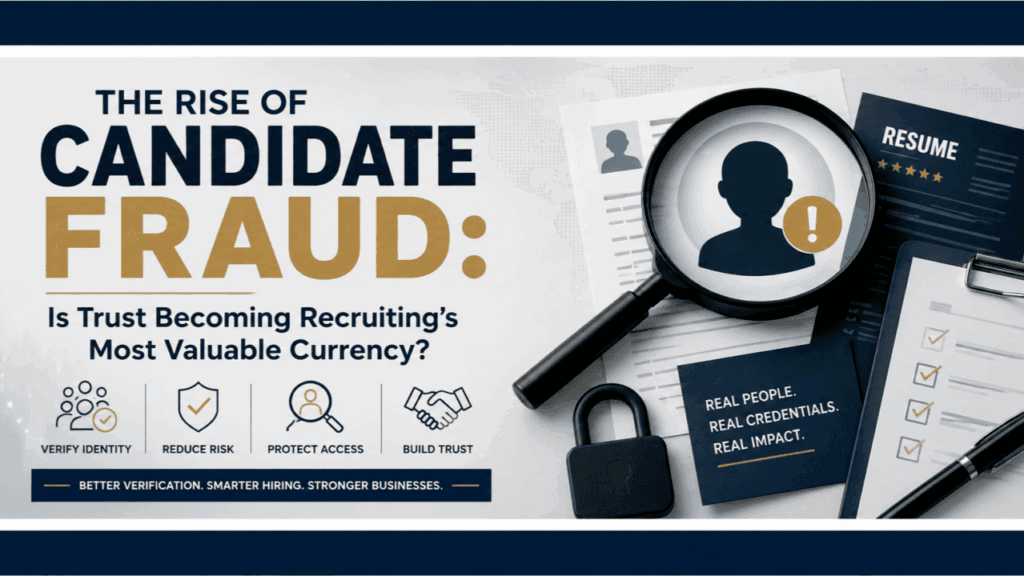
But somewhere along the way, we created a new problem: How do we know the person we’re interviewing is actually the person they claim to be?
Candidate fraud isn’t hypothetical anymore; and I’m not talking about someone exaggerating their Excel skills or adding a few months to their employment dates.
We’re seeing fake identities, fabricated work histories, AI-assisted interviews, proxy interviewers, falsified credentials and, in some cases, entirely fraudulent workers getting hired and gaining access to company systems through global organized crime rings.
The numbers should get employers’ attention. In a 2025 Gartner survey of 3,000 job candidates, 6% admitted participating in interview fraud by either posing as someone else or having someone else interview on their behalf. Gartner has predicted that by 2028, one in four candidate profiles worldwide could be fake or contain material identity misrepresentation.
Greenhouse, citing Gartner research, reported that only 7% of recruiting leaders were using identity-document validation software at the time of Gartner’s survey, while 54% agreed AI had made candidate fraud a significantly larger problem. This isn’t simply a recruiting-quality issue; it’s a huge business risk.
Candidate Fraud Has Become a Cybersecurity Problem
One of the most extreme examples comes directly from the U.S. government. In 2024, the Department of Justice announced charges related to a scheme in which overseas IT workers allegedly used stolen or borrowed U.S. identities to obtain remote jobs. According to the DOJ, the operation infiltrated more than 300 U.S. companies.
The FBI has continued warning employers about these schemes, including workers using false identities, U.S.-based facilitators, remote-access technology and even AI and face-swapping technology during video interviews. Once inside organizations, some actors have allegedly stolen proprietary information and source code or attempted extortion.
That’s why I think companies need to stop viewing candidate fraud solely as an HR problem, it belongs on the radar of HR, Talent Acquisition, IT, cybersecurity, legal and business leadership.
The question isn’t simply “Did we hire the right candidate?” It’s increasingly: “Did we verify who we just gave access to our company?”
AI Didn’t Create Candidate Fraud. It Made It Easier to Scale.
Let’s be honest, candidates have embellished résumés forever. What’s different today is the sophistication and scale.
Generative AI can help someone create a highly polished résumé and cover letter in minutes. Technology can assist candidates during assessments and interviews. Synthetic media can make identity verification more difficult. And remote hiring means a candidate may never physically meet anyone from the company before receiving equipment and system access.
Gartner found that among job seekers using AI, 54% used it to generate résumé or CV content, 50% for cover letters, 36% for writing samples and 29% for assessment answers. Most of those uses aren’t inherently fraudulent—but they demonstrate how much harder it has become for employers to determine what represents a candidate’s actual capabilities.
The answer isn’t to eliminate AI from recruiting, it’s to build better verification into the hiring process.
A Practical Candidate Fraud Playbook for Employers
Companies don’t need to make candidates feel like they’re going through airport security. But they do need intentional checkpoints.
1. Verify identity earlier.
Don’t wait until after an offer to discover inconsistencies. For higher-risk or remote roles, consider appropriate identity-verification steps earlier in the process, consistent with applicable laws and company policy. The FBI specifically recommends identity verification during interviewing, onboarding and throughout employment for remote workers.
2. Require live interaction.
For remote positions, incorporate live video conversations and consider a mandatory in-person interview when the role, location and circumstances make that reasonable. Gartner reported in 2025 that 81% of organizations responding to candidate fraud were using video interviews and 74% were using in-person interviews. Requiring an onsite interview can help mitigate some of the risk.
3. Stop relying entirely on scripted interview questions.
Ask follow-up questions. Ask candidates to explain projects in detail. Ask how they solved a particular problem. Ask what went wrong. Ask what they would do differently. Someone reading prepared or AI-generated responses will often struggle when the conversation becomes specific and unpredictable.
4. Validate employment and credentials through a verified Background check vendor
Don’t assume a polished LinkedIn profile equals verification. For appropriate positions, confirm employment history, education, licenses, certifications and references through established processes.
5. Watch for inconsistencies.
Names, addresses, phone numbers, locations, employment dates and communication patterns should make sense across the recruiting and onboarding process. The FBI specifically recommends watching for address changes before equipment is shipped, inconsistencies about location or work history, and reused contact information across supposedly different applicants.
6. Bring IT and cybersecurity into remote hiring.
If you’re hiring remote workers with access to sensitive systems, code, financial information, customer data or intellectual property, candidate verification shouldn’t live exclusively inside Talent Acquisition. HR verifies the employee. IT protects the access. All of those processes need to connect.
7. Audit your staffing partners.
Don’t assume a third-party recruiting or staffing company is handling verification simply because they’re sending you candidates. Ask. Verify that your third-party staffing firms have robust hiring practices and routinely audit those practices.
Is This Why Employee Referrals Are Having a Moment Again?
There’s another hiring trend I’ve been watching that I don’t think is unrelated. Companies are putting renewed emphasis on employee referrals and trusted networks.
It makes sense.
When employers are overwhelmed with hundreds or thousands of online applicants, many of them AI-optimized and increasingly difficult to evaluate, a candidate who comes through someone you trust carries a different signal.
And referrals continue to produce. A 2025 analysis of more than 1.1 million employee referrals found that roughly one in 10 referrals resulted in a hire. By comparison, employers may need more than 50 to 60 job-board applicants to generate one hire.
But there’s an important caveat.
A referral should create access but not eliminate scrutiny.
A referred candidate should still go through your interview process, verification requirements and hiring standards. SHRM has specifically cautioned employers against giving referred candidates less scrutiny simply because a trusted employee recommended them.
That’s an important distinction. The future of recruiting probably isn’t going back to “we only hire people somebody knows.” It may, however, involve rebuilding something technology has slowly removed from recruiting: trust.
Trusted recruiters. Trusted employee networks. Trusted professional communities. And verification when trust alone isn’t enough.
For years, recruiting technology has been designed around one primary objective: make hiring faster and easier. The next generation of recruiting technology and recruiting strategy may need to answer a different question: How do we make hiring easier without making fraud easier too?
Because in today’s environment, knowing whether someone can do the job is only part of the hiring decision.