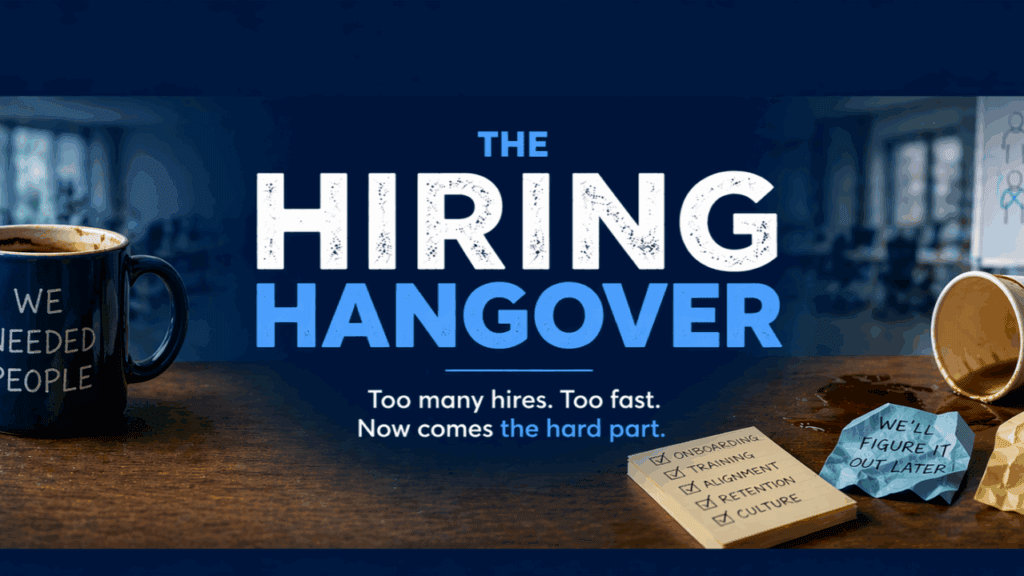
Remember 2021? Talent was the hottest commodity on the planet. Companies, flush with pandemic-era capital and optimistic growth projections, went on a hiring spree unlike anything we’d seen in a generation. Engineering teams doubled. Operations headcount ballooned. “Move fast and hire everyone” became the unofficial motto of the era.
Then reality arrived.
The Hangover Sets In
By late 2022 and into 2023, the macroeconomic picture had shifted dramatically. Interest rates climbed. Investor patience thinned. Growth-at-all-costs gave way to profitability-at-all-costs. And companies found themselves staring at org charts that no longer matched their business models.
The layoffs that followed weren’t random. They were, in many ways, the predictable outcome of hiring decisions made without enough rigor. Roles created to signal momentum rather than solve problems. Headcount added to match competitors rather than serve customers.
The hangover was painful. But here’s what’s interesting: the firms navigating it best aren’t just cutting their way back to health. They’re rebuilding with a fundamentally different operating model in mind.
Enter AI and a New Definition of Capacity
Here’s where the story gets more nuanced. The workforce recalibration happening right now isn’t only about correcting past excess. It’s also about a genuine shift in what human labor is needed for.
AI tools, from coding assistants to autonomous agents, are quietly changing the productivity math. A team of 10 engineers supported by the right AI stack can, in many contexts, do what 15 or 20 could do just two years ago. The same is true in legal, finance, marketing, and customer operations.
This creates a double pressure: companies are shrinking headcount to right-size for today’s revenue, while also recalibrating what their future workforce needs to look like as AI capability compounds.
What Leaders Should Be Asking Right Now
This moment demands honest questions. Not just “how many people do we need?” but “what kinds of work still require human judgment, creativity, and relationship?” The firms that answer that question well will build leaner, more adaptable teams. The ones that simply slash and hope will find themselves under-resourced for the rebound.
A few principles worth holding onto:
- Hire for judgment, not just execution As AI handles more routine tasks, the premium on human insight and decision-making goes up, not down.
- Treat AI literacy as a core competency The employees who will thrive aren’t those who resist these tools. They’re those who learn to extend their effectiveness through them.
- Don’t confuse efficiency with strategy Cutting costs is a tactic. Knowing what you’re building toward is the strategy. The two need to be aligned.
The Hangover Will Pass
Every hiring cycle has its correction. What’s different this time is that the correction is happening alongside a genuine transformation in how knowledge work gets done. The companies that emerge strongest won’t be those that simply hired less. They’ll be the ones that hired smarter, equipped their teams with the right tools, and built organizations nimble enough to adapt as the landscape keeps shifting.
Most organizations have gotten through the cutting. Far fewer have a clear answer for what comes next.