
Kim Dubé Founder & CEO | ReFlex: Recruiting FlexibilityTalent Acquisition Executive | HR Consultant
Every so often, something happens that shifts the conversation across an entire industry. I believe the lawsuit against Workday has the potential to be one of those moments for Talent Acquisition.
To be clear, this isn’t because AI is going away. Quite the opposite. Artificial intelligence is becoming deeply embedded in nearly every stage of the hiring process. Recruiters are using it to source candidates, draft job postings, summarize interviews, schedule meetings, and identify potential matches more efficiently than ever before. Organizations have embraced AI because it solves real business problems and in many cases, it does so exceptionally well.
The lawsuit itself is still working its way through the courts, and Workday has denied the allegations. However, a federal judge recently allowed key portions of the case to move forward, including claims alleging that AI-driven hiring technology may have disproportionately screened out applicants based on protected characteristics such as age, race, and disability. Whatever the final outcome, the case has already sparked an important conversation among HR and business leaders: How much of the hiring process should technology influence, and where should human judgment begin?
That question couldn’t come at a more relevant time. According to recent SHRM and Resume Builder research, most employers now use AI somewhere in their hiring process. For many organizations, AI is no longer viewed as an emerging technology, it’s become part of the standard recruiting toolkit. From my perspective, the issue has never been whether AI belongs in recruiting. It absolutely does.
The question is whether we’ve become so focused on efficiency that we’ve started to confuse automation with good decision-making.
Over the past decade, organizations have worked to remove friction from hiring. Resume screening became automated. Candidate ranking became algorithm-driven. Knockout questions filtered applicants before a recruiter ever reviewed their experience. These innovations have undoubtedly helped recruiters manage larger applicant pools and reduce administrative work.
The problem is. that after more than 20 years in Talent Acquisition, some of the strongest candidates I’ve helped place were not the obvious choice on paper. They were career changers, military veterans, parents returning to the workforce, or professionals with transferable skills that didn’t perfectly align with a job description. A keyword search may not have surfaced them, but a conversation did.
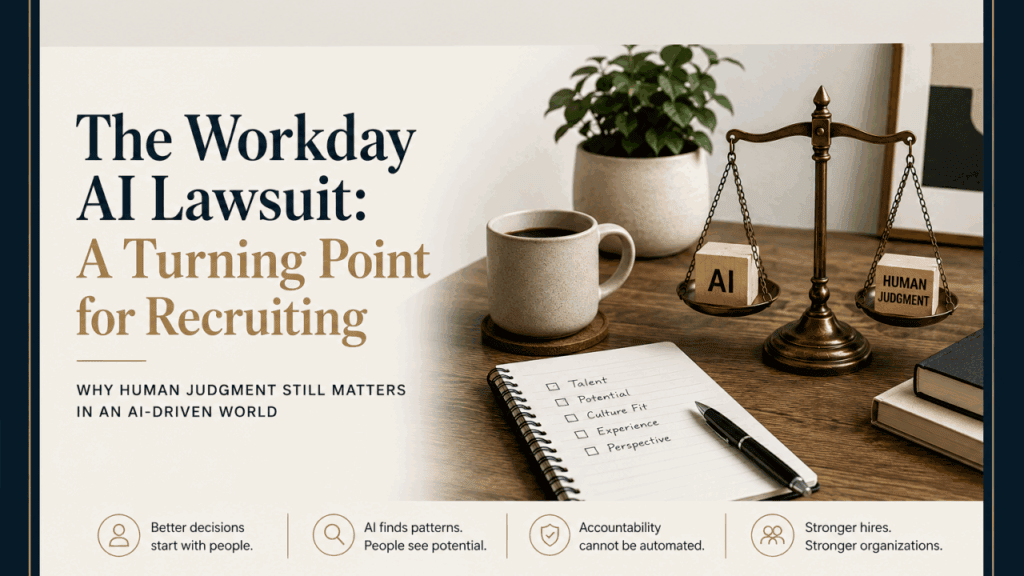
That’s why I don’t see this lawsuit as an indictment of AI. I see it as a reminder of where accountability ultimately belongs.
Technology can identify patterns, surface insights, and improve productivity. It can help recruiters spend more time building relationships and less time completing administrative tasks. What it cannot do is fully understand context, potential, motivation, resilience, or the qualities that often distinguish a great hire from a merely qualified one. Those decisions still require people.
I believe we’re entering the next phase of recruiting; not one where organizations retreat from AI, but one where they become more intentional about how it’s used. The companies that will attract and retain the best talent won’t necessarily be those with the most sophisticated technology. They’ll be the ones that know how to combine technology with experienced recruiters who understand that hiring is both a science and a human decision.
If the Workday lawsuit leaves our industry with one lasting takeaway, I hope it’s this: AI should make recruiters better; not make recruiters unnecessary.